El Batán Hotel Spa
There is a singular refuge in the southern mountains of Jaén, where water sets the rhythm of everything that happens there—this is El Batán.
El Batán Hotel Spa
There is a singular refuge in the southern mountains of Jaén, where water sets the rhythm of everything that happens there—this is El Batán.
Its name comes from an old water-powered mechanism: a large wheel and heavy wooden hammers that would both strike hides and fabrics to full them, and grind grain or olives. All of it driven by the force of water.
Because indeed, El Batán and water are one. Past and present coexist through the current of the San Juan River.
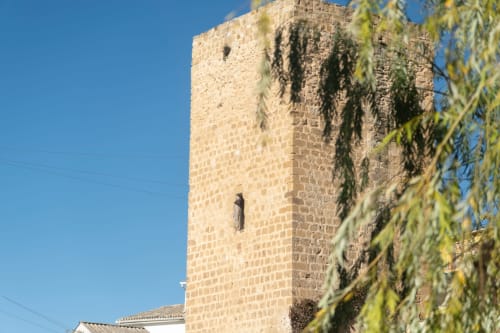
The emblem of the place is: The Tower of El Batán.
Back in the year 1243, the Andalusian poet Ibn Said al-Maghribí described it as: “…a quadrangular construction that not only formed part of the landscape, but rose like a fortress, on the banks of the only crossing point of the San Juan River, in a time when bridges did not yet exist.”
Over the centuries, the tower lost its military character and was transformed into a silo; a place where wheat rested in summer, before mills turned it into flour, thus sustaining and supporting the daily life of the region.
The tower still stands, with an imposing presence, guarding the river ford and the Triana bridge, carrying the passage of time within its walls.
Another key element in the history of El Batán was: The oil mill.
A stone building, constructed around the year 1600, whose main feature was the use of water power to move the conical granite millstones that crushed the olives.
The water was channeled through a sluice that lifted it, generating the energy needed to set the machinery in motion.
Today, the oil mill is a place of relaxation, where the water no longer needs to move those stones (which now rest at the foot of the tower)… now it generates a different kind of energy… one that offers balance and calm to those who visit.
And finally, though no less important, the human character of this place is due to María Encarnación Erazo-Aranda Salazar e Infante, 11th Countess of Humanes (1845).
Around 1880, she inherited from her grandfather important properties linked to the Castle of Locubín.
Her altruistic nature led her to become a benefactor of the town, promoting improvements that transformed the lives of its inhabitants; notably her contribution to the creation of an irrigation system that enabled the agricultural development of the orchards, as well as the donation of those lands to the farmers.
During her frequent visits to the region, the countess stayed at El Batán.
Over time, these stays became longer, and little by little, she felt so emotionally connected to the place that she eventually turned it into her stately residence.
That space, which in its origins had been a fortress, a nucleus, and an economic engine, became, thanks to her, a home.
And, without intending to, she became a bridge between the past, her present, and today.
And in that present, El Batán is a place born from the strength of the water that flows directly from the channel.
While the waterfall flows endlessly, the walls, the stone, and the rock formations hold the history.
The tower remains. The oil mill now enjoys being a spa, and the old manor house continues to welcome guests, now transformed into a hotel.
It is a home open to the world, where every corner remembers, yet at the same time invites you to live in the present, to pause… or perhaps to let yourself be carried by the current.
Water in motion that connects past and present, that flows, whispers, and restores, waiting for you to also become part of its story.
Its name comes from an old water-powered mechanism: a large wheel and heavy wooden hammers that would both strike hides and fabrics to full them, and grind grain or olives. All of it driven by the force of water.
Because indeed, El Batán and water are one. Past and present coexist through the current of the San Juan River.
The emblem of the place is: The Tower of El Batán.
Back in the year 1243, the Andalusian poet Ibn Said al-Maghribí described it as: “…a quadrangular construction that not only formed part of the landscape, but rose like a fortress, on the banks of the only crossing point of the San Juan River, in a time when bridges did not yet exist.”
Over the centuries, the tower lost its military character and was transformed into a silo; a place where wheat rested in summer, before mills turned it into flour, thus sustaining and supporting the daily life of the region.
The tower still stands, with an imposing presence, guarding the river ford and the Triana bridge, carrying the passage of time within its walls.
Another key element in the history of El Batán was: The oil mill.
A stone building, constructed around the year 1600, whose main feature was the use of water power to move the conical granite millstones that crushed the olives.
The water was channeled through a sluice that lifted it, generating the energy needed to set the machinery in motion.
Today, the oil mill is a place of relaxation, where the water no longer needs to move those stones (which now rest at the foot of the tower)… now it generates a different kind of energy… one that offers balance and calm to those who visit.
And finally, though no less important, the human character of this place is due to María Encarnación Erazo-Aranda Salazar e Infante, 11th Countess of Humanes (1845).
Around 1880, she inherited from her grandfather important properties linked to the Castle of Locubín.
Her altruistic nature led her to become a benefactor of the town, promoting improvements that transformed the lives of its inhabitants; notably her contribution to the creation of an irrigation system that enabled the agricultural development of the orchards, as well as the donation of those lands to the farmers.
During her frequent visits to the region, the countess stayed at El Batán.
Over time, these stays became longer, and little by little, she felt so emotionally connected to the place that she eventually turned it into her stately residence.
That space, which in its origins had been a fortress, a nucleus, and an economic engine, became, thanks to her, a home.
And, without intending to, she became a bridge between the past, her present, and today.
And in that present, El Batán is a place born from the strength of the water that flows directly from the channel.
While the waterfall flows endlessly, the walls, the stone, and the rock formations hold the history.
The tower remains. The oil mill now enjoys being a spa, and the old manor house continues to welcome guests, now transformed into a hotel.
It is a home open to the world, where every corner remembers, yet at the same time invites you to live in the present, to pause… or perhaps to let yourself be carried by the current.
Water in motion that connects past and present, that flows, whispers, and restores, waiting for you to also become part of its story.